

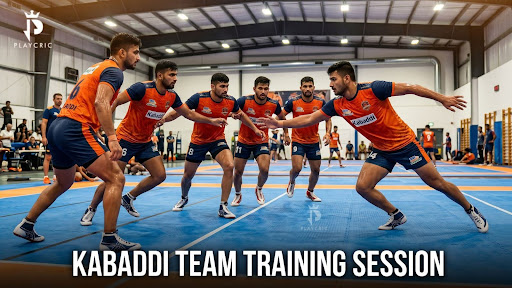
A raider crosses the baulk line. Defenders close in fast. Breath held. Body low. Every muscle fires at once. To put it simply, this is Kabaddi. It is raw, explosive, and deeply technical. Also, many people think Kabaddi is just about running and tagging. In fact, that is far from the truth. Instead, it is a breath-controlled, split-second decision sport.
Without a proper kabaddi training guide, even the most athletic players break down under match pressure. Playcric guide covers everything. From position-based fitness to game-specific raiding and defensive techniques, you will find exactly what it takes to train like a serious Kabaddi player.
Kabaddi Stands Out From Every Other Sport
Kabaddi is the only sport where breath control is a rule. In other words, a raider must chant continuously. They should not inhale from the moment they cross the baulk line. On top of that, every raid lasts only 4 to 6 seconds. So every movement must be instinctive. There is simply no time to think. As a result, players must train for:
- Quick starting speed from the baulk line
- Breath control during tackles and contact
- Grip strength for defensive catches
- Balance and flexibility for advanced raiding kicks
Beyond individual skills, Kabaddi is one unique sport. It needs both individual skill and team coordination at the same time. For that reason, training must always cover both.
Position-Based Fitness: Raiders vs Defenders
Fitness Training for Raiders
Raiders need explosive power above everything else. First and foremost, they must close the distance between the baulk line and defenders in under two seconds. Therefore, this kabaddi training guide recommends the following for raiders:
- Box jumps to build leg explosiveness for the Frog Jump technique
- Single leg squats to develop the balance needed for the Scorpion Kick
- Hip flexor and hamstring stretches: Because the Scorpion Kick requires the raider to curl one leg backwards while facing away from defenders
- Resistance band sprints to develop that explosive first step
Without strong hip flexors, the Scorpion Kick collapses completely under match pressure. That said, no amount of technique works without the right physical base.
Fitness Training for Defenders
Defenders need a completely different physical profile. Moreover, their strength must be anchoring strength, not just raw power. With that in mind, defenders should focus on:
- Grip and forearm training through towel pull-ups for the Crocodile Catch and Wrist Catch
- Lower body anchoring drills to absorb a raider’s full momentum during the Ankle Catch and Thigh Catch
- Lateral quickness drills to cut off raider escape routes before the baulk line
Raiding Techniques and How to Train Them
Every raiding technique works best in a specific game situation. Therefore, training must always reflect real match scenarios. In fact, here is what every serious kabaddi training guide must include:
Leading Foot Raid with Turning Hand Touch
This technique requires explosive acceleration and a full arm stretch. It works best when defenders stand upright and spread apart. To build this, train with shoulder flexibility drills and resistance band acceleration work.
Toe Touch
The raider ducks low and attacks with the feet. It works perfectly against a crouching defender. Most importantly, always train the full sequence: entry, duck, tag, and escape as one complete movement.
Scorpion Kick
The raider turns away from defenders. And then the player curls the leg backwards. It is a high-surprise move. Furthermore, it requires balance, flexibility, and speed working together. Start with slow motion repetitions first. Then gradually build to full speed.
Mule Kick and Side Kick
Both techniques rely heavily on deception. Essentially, the raider fakes one direction before executing the move. Train with feint and kick drills so the body naturally learns to disguise intent.
Frog Jump
The raider launches above incoming defenders and tags mid-air. To master this, train with explosive jump drills and landing control exercises. Without a doubt, core stability is absolutely critical here.
Defensive Techniques and Game-Specific Drills
Defense in Kabaddi is a coordinated trap. It is never a solo effort. Furthermore, every catch has a specific trigger moment. Accordingly, this kabaddi training guide breaks it all down clearly:
Ankle Catch
The defender grabs the raider’s ankle. And pulls away from the midline. It works best when the raider is mid-stride and off balance. Therefore, practice ankle catch timing drills with correct body positioning throughout.
Crocodile Catch
The defender grabs the raider’s arm from a distance first. Then pulls it closer in one fluid motion. However, grabbing too early gives the move away completely. Therefore, train with distance grab and pull drills consistently.
Wrist Catch and Knee Catch
Both require quick hands and strong grip. As a result, train with wrist grab reaction drills where the defender reacts to the raider’s hand movement in real time.
Chain Defense
Multiple defenders link together to trap the raider. This requires clear team communication above all else. Additionally, train with hand signals and eye contact drills so defenders coordinate without alerting the raider. Playcric shows that organized chain defense works better than individual talent in Kabaddi. Team coordination makes the real difference.
Connection Between Breathing and Kabaddi Endurance
The reality is that breath control is the single most underrated skill in Kabaddi. Moreover, it separates good raiders from great ones. For example, when a raider executes a Frog Jump, the body instantly wants to gasp on landing. As a result, training must work to suppress this reflex. Include these in your kabaddi training guide:
- Shuttle runs while chanting at increasing distances
- Contact breath drills where the raider executes a Toe Touch while chanting under light pressure
- Kumbhaka Pranayama, a yoga breath retention technique that significantly expands lung capacity
Notably, Playcric analysis shows that most raid failures at competitive levels happen because raiders inhale too early under physical pressure. Therefore, breath training is simply non-negotiable.
Weekly Training Schedule for Kabaddi Players
| Day | Focus | Game Goal |
| Monday | Explosive strength and grip training | Build base for Frog Jump and Crocodile Catch |
| Tuesday | Raiding technique drills with live defenders | Practice full entry, tag, escape sequence |
| Wednesday | Breath control under physical stress | Train chanting under contact pressure |
| Thursday | Defensive catch drills and team coordination | Execute Chain Defense as a synchronized unit |
| Friday | Agility, feint, and deception drills | Train body fakes for Side Kick and Mule Kick |
| Saturday | Full match scrimmage with position review | Apply all techniques under real match pressure |
| Sunday | Active recovery and mobility work | Protect ankles, knees, and hip flexors |
Food and Recovery for Kabaddi Players
Raiders burn energy in short quick bursts. For this reason, fast-releasing carbohydrates before training sessions are essential. On the other hand, defenders need high protein intake for grip and thigh muscle repair. Furthermore, breath control training accelerates dehydration faster than standard cardio. Because of this, hydration must stay consistent throughout the day.
Recovery must focus on hip flexors, hamstrings, ankles, and wrists. After all, these are the highest injury risk areas in Kabaddi. As a daily habit, Playcric recommends foam rolling and ankle mobility work for all active Kabaddi players.
The Mat Rewards the Most Prepared Player
Kabaddi mastery does not come from raw talent alone. Instead, it comes from deliberate, game-specific preparation. Overall, this kabaddi training guide gives you a solid framework to work from.
Basically, start with one technique. Master it completely. Then build your game step by step from there. Ultimately, the mat does not lie. Your preparation shows in every single raid and every catch. So begin today.
FAQs
- I just started Kabaddi. How many days should I train in a week?
Start with three days. Build to five gradually. Most importantly, never skip rest days.
- My raids keep failing because I run out of breath. What should I do?
Practice chanting during short jogs daily. Then increase the distance slowly over time. Additionally, try yoga breath retention as well. Give it a solid four weeks.
- Which raiding technique should a beginner learn first?
Start with the Toe Touch. It is simple and effective. However, avoid the Scorpion Kick and Frog Jump early on. Build your flexibility first.
- Our team defense keeps falling apart. How do we fix this?
It is a coordination problem, not a fitness one. Therefore, practice Chain Defense drills regularly. Also, use hand signals between players. In most cases, two focused weeks of team drills will fix this.




Leave a Reply