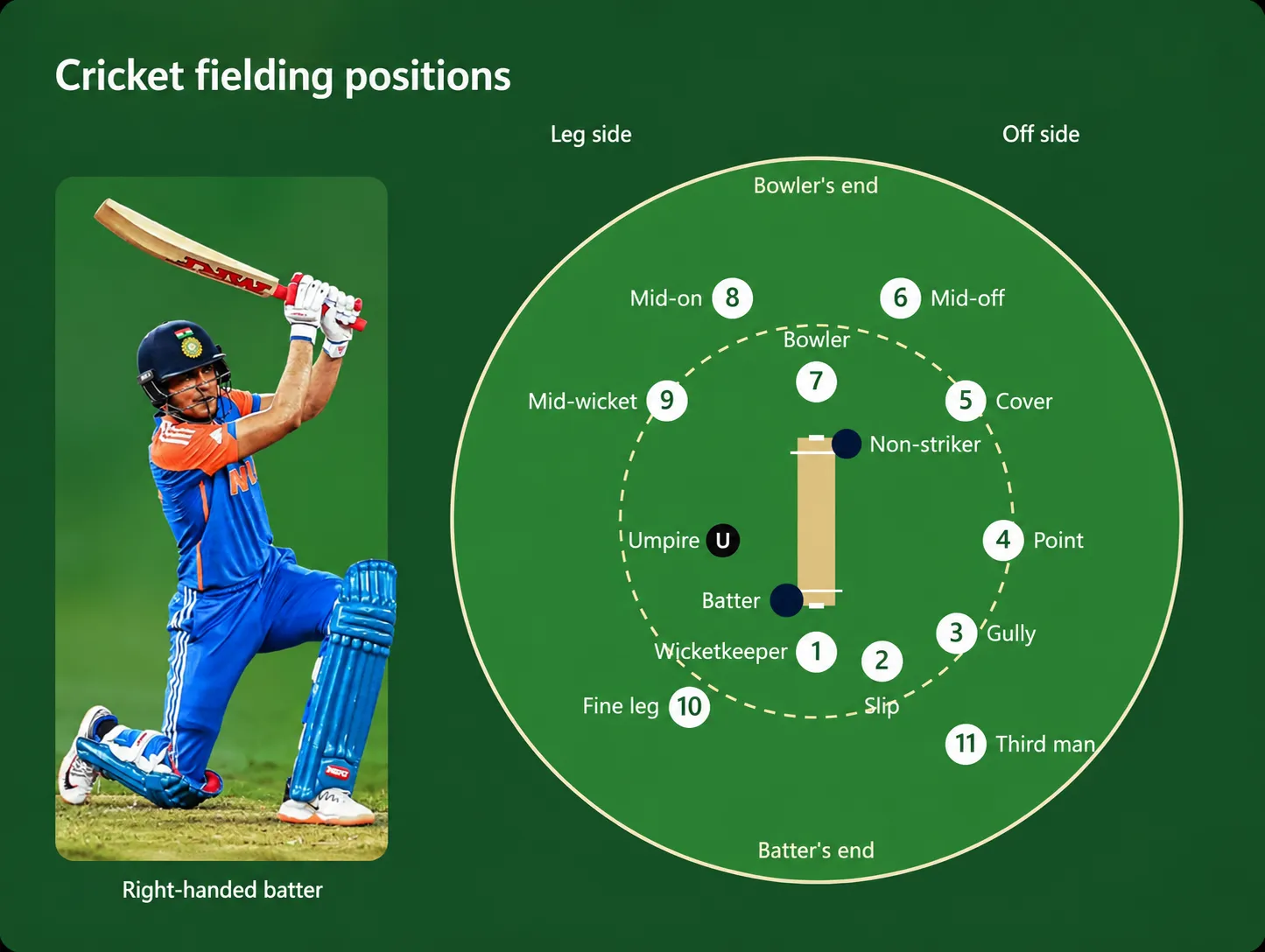
Do you know why fielders adopt such strange positions while playing cricket? Some stand behind the batter, while others position themselves close to the boundary ropes. Each spot has a clear purpose.
Knowing these cricket fielding positions helps you enjoy the game more. It also helps you sound like an expert when you watch cricket, virtual or real.
A team has 11 players on the field. One bowls, and one keeps the wicket. The other 9 fielders are spread across different spots. The captain sets these placements based on the pitch, bowler, format, and match tactic. Let’s look at each position in detail.
The Two Sides of the Cricket Field
The field splits into two main sides relative to a right-handed batter. The offside sits to the batter’s right and front. The leg side, also called the on side, stays to the batter’s left and back. In addition, these are the sides from which the changes will occur when the left-handed players bat. Therefore, the fundamental principle will help to understand the duties of the cricket fielding positions.
Behind the Wicket: Catching & Edge Protection
These positions on the cricket field defend the edge and opportunities for catching. The wicketkeeper stands right behind the batter’s stumps. This player catches balls that have been caught low, collects deflections, and runs out batters. Meanwhile, the only individual allowed to wear gloves and pads while acting as a fielder is the keeper.
Slips (1st, 2nd, 3rd, 4th)
Slip fielders stand diagonally behind the wicketkeeper on the offside. They catch edges that fly off the bat. The slip fielding position in cricket helps in catching thick edges from aggressive shots. Also, captains often place multiple slips when fast bowlers bowl with the new ball, making this one of the most valuable cricket fielding positions in the game.
Gully
A gully fielding position in cricket stands more squarely than slips on the offside. This fielder catches hard cuts and late defensive edges. As a result of the ball moving fast, a good gully needs reflexes.
Leg Slip
This fielder stands behind the batter on the leg side. Teams use leg slip against slow bowling or short-pitched bowling.
Fine Leg / Short Fine Leg
Fine leg stands behind square on the leg side. Moreover, this fielder collects glanced or flicked shots. Thus, the fine leg in cricket often saves valuable runs near the boundary.
Third Man / Short Third Man
The third man in cricket stands fine off the slips on the off side. This position stops late dabs and edge trickles. The short third man moves closer to save singles.
Square of the Wicket: Inner Ring & Saving Singles
Smart cricket fielding positions explained in the inner ring save singles. First, the point stands square on the wicket on the off side. Overall, this fielder stops sharp cut shots and needs high agility. The backward point sits slightly behind the point for extra cover.
Cover / Extra Cover
Cover is the fielder’s position in front of the point on the off side. They cut off crisp-cover drives. Therefore, the point and cover in cricket positions demand excellent anticipation and speed.
Square Leg / Backward Square Leg
The square leg stands square on the wicket on the leg side. Likewise, this fielder collects pull and sweep shots. Similarly, the backward square leg sits slightly behind for extra protection.
Short Leg / Silly Point
Short leg stands extremely close to the batter on the leg side. Silly point does the same on the off side. These brave fielders snap up quick bat-pad catches off slow bowling or short balls.
In Front of the Wicket: Straight & Mid-Region
Useful cricket fielding positions in front of the wicket block for straight drives. First, the mid-off stands on the off side in line with the bowler. This fielder blocks straight drives and collects quick singles.
Then mid-on mirrors mid-off on the leg side. Also, this fielder is used to catching straight hits and mid-wicket hits. Next, the mid-wicket is between mid-on and square leg. This fielder is responsible for blocking flicks and turning off drives.
Fans on Playcricnews often discuss how cricket fielding positions change with match format. For instance, mid-wicket becomes crucial against slow bowling.
The Boundary / Deep Field: Saving Fours
The deep cricket fielding positions are used for the protection of the rope. First, stand deep and close to the boundary, deep, both long off and long on. They prevent the high drives from becoming sixes or fours.
Meanwhile, deep cover sweeps the off-side boundary of hard-hit drives. Last but not least, deep mid-wicket and deep square leg defend the deep leg-side boundary from heavy pull, sweep and slog shots.
Why Field Positions Change
Captains shift cricket fielding positions as match situations evolve. Pitch conditions, bowler style, batter handedness, and format strategy all shape where players stand.
Format Strategy
Test cricket captains use close catchers like slips and short legs to hunt wickets. However, T20 and ODI captains push fielders to the deep boundary ring to prevent aggressive batters from hitting boundaries.
Bowler Type
A third man and slippers to the bowler are normally necessary with fast bowlers. On the other hand, slow bowlers have defenders who come in closer to the ball, such as silly point, short leg and catching mid-wicket. Therefore, the returning batsman is forced to wander around in a stutter-10 position for the slow bowler. Furthermore, fast bowlers often keep the third man in cricket for late edges.
Handedness
Captains mirror these when batting either right- or left-handed down the centre of the pitch. Overall, this means that fielders need to be fast on their feet.
Quick Summary of Key Positions
The following is an important reference that will help you know about the duties of each of the main cricket fielding positions.
| Fielding Position | Role & Description |
| Wicket-keeper | Behind stumps, catches and runs out |
| Slips | Diagonal behind the keeper catches edges |
| Gully | Square on/off side, catch cuts; the gully position in cricket needs quick hands. |
| Point | Square on/off side, stop cuts |
| Cover | Front of point, stop drives; the point and cover in cricket setup saves many singles |
| Mid-off/Mid-on | Straight, block drives |
| Square Leg | Square on the leg side, stop pulls |
| Fine Leg | Behind square, stop glances; a fine leg in cricket guards the rope. |
| Third Man | Fine on/off side, stop dabs |
| Long-off/Long-on | Deep boundary, stop sixes |
Final Thoughts
The knowledge of field placement helps you enjoy it better. Also, it changes the way you look at the game. Also, every fielder plays a crucial role. Their position is not random but backed by the game plan. So, next time watching a real cricket match or playing on an online platform, pay attention to field positions. You will spot attacking traps and defensive walls.
Finally, share your favourite fielding setup with fellow fans on Playcric and challenge your friends to name all cricket fielding positions during the next match. Ready to test your fielding knowledge? Pick your dream field placement and see how it changes the match!