Have you ever seen a raider jumping over the white line at the last second and wondered about the real kabaddi court size? Knowing the dimensions of the court will allow you to watch raids and tackles differently.
The official rules dictate the boundaries for the sake of player safety. This guide will inform you of the kabaddi court size and line markings for all age groups in clear and understandable language. Let’s look at the details.
Official Kabaddi Court Size by Category
Different age groups and genders play on slightly different mat sizes. Official bodies like the International Kabaddi Federation set these rules to keep matches fair and balanced. A standard kabaddi court size is always a flat rectangle split into two halves by a centre line.
When looking at the kabaddi court dimensions, you should know that there are three main types of courts for boys and men. The size and speed requirements imply the need for men and junior boys to have the biggest area for their sport, while women, junior girls, and kids need more modest sizes of playing fields.
Men and Junior Boys Category
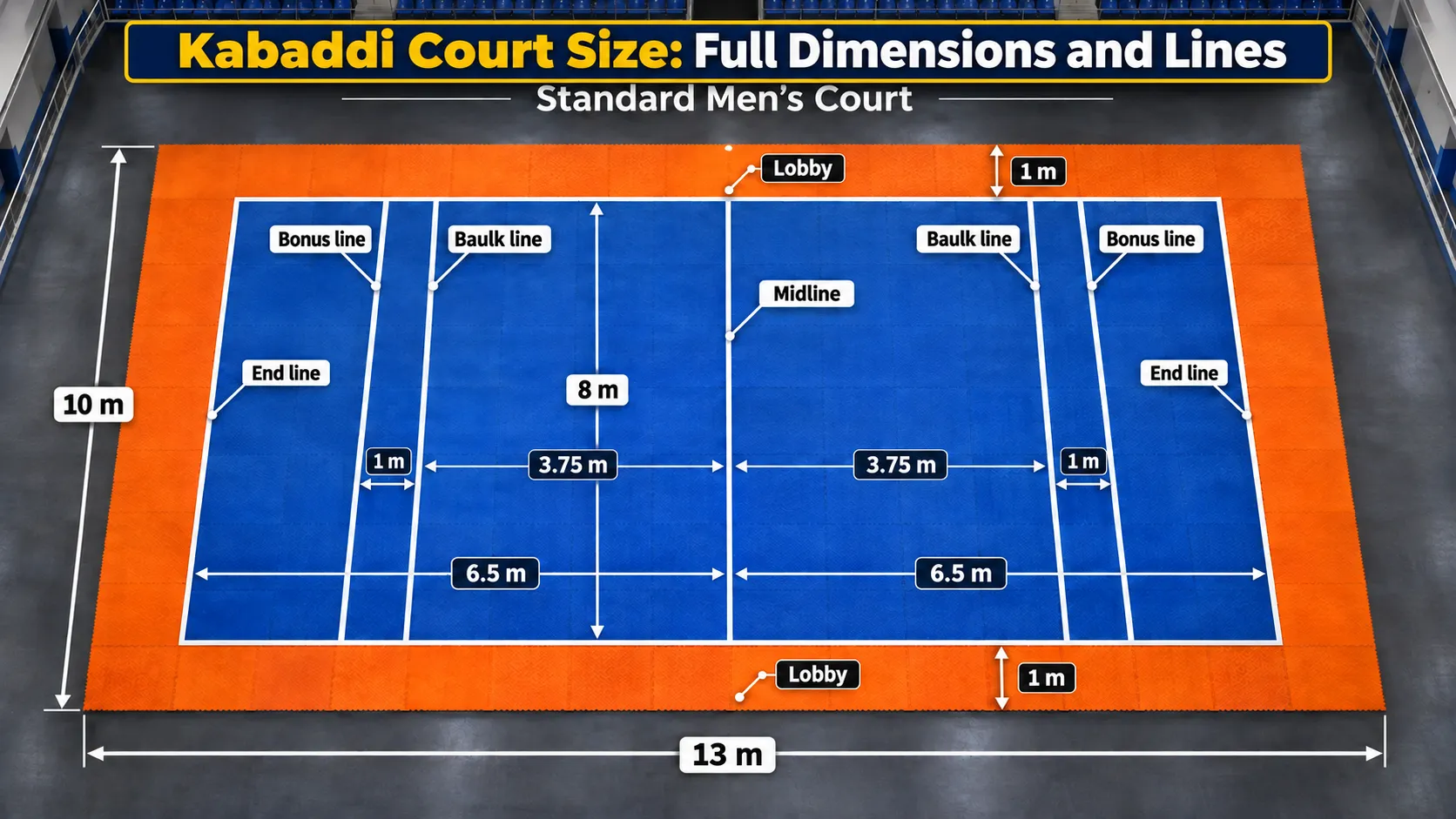
- Total Length: 13 metres between the two back-end lines.
- Total Width: 10 metres from one outer side edge to the other.
- Half-Court Length: 6.5 metres per team territory.
- Diagonal Check: 16.40 metres from corner to corner to guarantee true 90-degree angles.
Women and Junior Girls Category
- Total Length: 12 metres from end to end.
- Total Width: 8 metres across, which includes the two outer side strips.
- Half-Court Length: 6 metres for each defending side.
- Diagonal Check: 14.42 metres across opposite corners.
Sub-Junior Boys and Girls Category
- Total Length: 11 metres in total length.
- Total Width: 8 metres in total width.
- Half-Court Length: 5.5 metres per half.
- Diagonal Check: 13.60 metres across the mat.
Exact Kabaddi Court Size in Feet and Metres
Many local organisers and fans prefer checking the kabaddi court size in feet instead of metres when marking out outdoor clay grounds. Converting these numbers makes setup much easier if your measuring tape only shows imperial units.
For a standard men’s match, the court size in feet is roughly 42.65 feet long by 32.80 feet wide. Women play on a rectangle measuring about 39.37 feet by 26.25 feet. Meanwhile, sub-junior players compete in an area that measures 36.09 feet by 26.25 feet. Every boundary line must be 3 cm to 5 cm thick, using bright white tape or lime powder.
Breakdown of Internal Lines and Markings
A rectangle alone does not make a playable mat. Inside the outer borders of any standard kabaddi court size, specific lines control how raiders score points and how defenders trap them. Getting every kabaddi court measurement right keeps the rules strict during high-speed action.
1. The Mid-Line
This centre line cuts the kabaddi court into two halves. Each side holds seven active players. Once a raider crosses this line into the opponent’s zone, the raid officially starts.
2. The Baulk Line
The baulk line runs parallel to the mid-line on both halves. On a men’s mat, it sits 3.75 metres away from the centre. For women and sub-juniors, that gap drops to 3 metres. A raider must cross this line cleanly with at least one foot while the other foot is in the air, unless they touch a defender first.
3. The Extra Point Line
Located exactly 1 metre beyond the baulk line toward the back boundary, this line stays at the same 1-metre offset across all divisions. On a men’s mat, it sits 4.75 metres from the centre line. Raiders earn an extra point by crossing it when six or seven defenders stand active on the mat.
4. The End Line and Side Lobbies
The end line marks the back border of each half, sitting 1.75 metres behind the extra point line for men. Along both long edges, two 1-metre-wide side lobbies run from end to end. Before a physical touch happens, active play stays inside the inner 8-metre width for men and 6-metre width for women. Once a defender touches the raider, those side lobbies open up as legal ground.
Surrounding Clearance and Safety Zones
You cannot place a mat right next to a brick wall or metal fence. Fast tackles often push players flying out of bounds at full speed. Because of this risk, the total kabaddi ground size must be much larger than the active kabaddi court size itself.
Organisers must leave at least 4 metres of clear, flat buffer space around all four sides of the court. Therefore, a safe venue requires a minimum kabaddi ground size of 20 metres by 20 metres, or at least 17 metres by 18 metres for indoor halls.
Behind each end line, you will also find sitting blocks placed 2 metres away from the back border. Players who get tagged out sit inside these boxes while waiting for a revival. Each sitting block measures 1 metre wide by 8 metres long for men and 1 metre by 6 metres for women.
Setting Up the Ideal Kabaddi Field Size
Whichever of the proposed methods you choose for laying out your kabaddi field, remember that precision is important. Checking every detail of the size of your field will help avoid problems in the future.
Always measure the diagonal distance first to be sure that all corners are square. After that, check each dimension from the middle line going towards the back edge, instead of measuring it from the latter. That simply allows avoiding potential mistakes with the tape. Checking the kabaddi court size beforehand will ensure fair play for everyone involved in the match.
Ready to Test Your Kabaddi Knowledge?
Have you ever wondered how professionals determine which player executed the perfect toe-touch by one inch? The knowledge of the kabaddi court size can make you develop similar precision skills while watching the game either online or in person. Official rules outline this size in detail in order to ensure the safety of the players and keep every game fair for any age group.
In the end, you possess the whole set of plans, ranging from the layout used in 13-metre men’s races up to the outer boundaries. These figures are useful for both beginners and those who have been watching the game for years.
Do you want to start playing with your own mat? Take a tape measure and get started! Visit Playcricnews for kabaddi and other helpful dimension and rule guides!